

Release Date: August 2026
Priority: Recommended
Affected Product: RI8607 50 GHz TestSet TIM (Testhead50)
Affected Software: All Cassini Short Cuts without Patch 332-141 (2026-08-10) or later
Purpose
The Mixer Protection Patch improves the long-term reliability of the RI8607 50 GHz TestSet TIM (Testhead50) by reducing Local Oscillator (LO) drive power above 20 GHz, helping prevent potential mixer damage. Because the patch changes the receiver response characteristics, it can impact absolute measurement performance unless a Receiver Frequency Response (WpGain) calibration is performed after the patch is installed. This update is expected for all factory calibrated TIMs.
Description
Patch 332-141 modifies LO power levels for frequencies above 20 GHz while maintaining existing source power performance and source calibration behavior. Patch 332-141 reduces Local Oscillator (LO) power from +20 dBm to +17 dBm for frequencies above 20 GHz to prevent potential mixer damage. The update is required to protect the internal mixer from excessive LO drive power. Following installation of the patch, a Receiver Frequency Response (WpGain) Calibration must be performed to restore absolute measurement accuracy.
Required Action
Use a Dev Short Cut with Patch 332-141 (or later) and perform Targeted Calibration Procedure (below) on each affected RI8607 50 GHz TestSet TIM.
All production and engineering sites should evaluate and release a Cassini Short Cut containing Patch 332-141 or later and avoid using a Cassini Short Cut without this patch after calibration is performed. If a Production Short Cut is in use, qualify the latest Dev Short Cut that includes this patch and request a new Production Short Cut from RI Support or, if possible, request a "Hardware Driver only" update to the Dev Short Cut that the existing Production Short Cut is based from RI Support ([email protected]).
Measurements Affected
Not Affected
- Source power values
- Source power calibration
- Relative measurements
- Absolute measurements from 2 GHz to 20 GHz
- Cassini Short Cuts with this patch.
- Absolute voltage measurements from 20 GHz to 30 GHz (most significant impact, typically less than 2 dB)
- Absolute voltage measurements from 30 GHz to 50 GHz (typically less than 0.5 dB)
- Receiver measurements when IF Gain setting causes results to exceed
- Cassini Short Cuts without this patch.
Required Equipment for Calibration
- Cassini Short Cut with Patch 332-141 (2026-08-10) or later
- Diag/Cal Plate configured with RI8607 50 GHz TestSet TIM, RI8586 25 GHz Sources and RI8596 25 GHz Receiver
- Power Meter and 50 GHz Sensor (PMeter77GHz)
Targeted Calibration Procedure
- Verify that Patch 332-141 (2026-08-10) or later is installed. To view loaded Cassini patches:
- From the Cassini application, select Options > Show Patches...
- Scroll through the list to locate GR10RC2A.332-141 and review the description in the summary pane below. (See Figure 1)
- Select Cancel to close the window, or select List All to open a text window that can be saved or searched.
- Connect the PMeter77GHz and 50 GHz power sensor using the standard calibration setup.
Reference "To Activate the Power Meter" in Calibration Procedure for RI8607 50 GHz TIMs https://roos.com/docs/RBES-C76VJ8 - Latch the Diag/Cal Plate configured for Testhead50.
- Open the Cassini Configuration window by selecting System > Tester.
- From the Cassini application, select System > Check to activate the Fixture and PMeter77GHz instruments.
- When prompted, select the calibration data corresponding to the connected power sensor.
- From the Configuration window, select Tester > Calibrate to open Cal Exec. (See Figure 2)
- Select Options > Select Cal Kit and choose the appropriate calibration kit. (Note: Cal Kit data is not used, only the Power Sensor instrument cal data must be valid)
- Select Ri8607A-RI8607A PortRF1 Rcv Freq Resp Cal and Ri8607A-RI8607A PortRF1 Rcv Freq Resp Validate.
- Select Run > Selected and follow all operator prompts.
- Select Ri8607A-RI8607A PortRF2 Rcv Freq Resp Cal and Ri8607A-RI8607A PortRF2 Rcv Freq Resp Validate.
- Select Run > Selected and follow all operator prompts.
- When the Calibration Saved message appears, the calibration is complete and the Testhead50 may be returned to normal operation.
With Patch 332-141 (2026-08-10) or Later Installed
- LO power is reduced by approximately 3 dB above 20 GHz. (See Figure 3)
- Mixer hardware reliability is improved by preventing excessive LO drive power.
- Receiver Frequency Response Calibration (WpGain) compensates for measurement changes introduced by the reduced LO power.
- Absolute measurement performance is restored following successful calibration.
- LO power is increased by approximately 3 dB above 20 GHz.
- Mixer reliability is reduced, allowing potentially excessive LO drive power that may damage the mixer.
- Receiver Frequency Response Calibration (WpGain) is invalid if it was performed with Patch 332-141 installed or if factory calibration data is being used.
- Absolute measurement performance can be restored by installing Patch 332-141 (or later) and performing a successful Receiver Frequency Response Calibration (WpGain).
The primary concern is a calibration mismatch, which occurs when the instrument is operated using calibration data that was generated with the opposite patch status. For example, using calibration data created with the patch installed while running measurements without the patch, or vice versa, can result in degraded absolute measurement accuracy. To maintain measurement integrity, calibration data and operating software should always have matching patch status. While relative measurements and source power calibration are generally unaffected, absolute measurements above 20 GHz may experience measurable errors when a mismatch exists. This service bulletin therefore recommends evaluating one of three implementation paths:
(1) continue using the current Production Short Cut without recalibration and take no action,
(2) calibrate using a Development Short Cut containing the patch, qualify the results, and release a new Production Short Cut with the patch, or
(3) calibrate using the patched Development Short Cut while retaining the existing Production Short Cut and qualifying devices against the resulting Testhead50 performance.
Calibration/Patch Compatibility Matrix
 Calibration Created With | Measurement Run With | Match Status | Expected Result |
Patch Installed | Patch Installed | ✅ Matched | Recommended configuration. Improved mixer reliability and calibrated measurement performance. |
No Patch | No Patch | ✅ Matched | Current behavior. Measurements consistent with existing calibration. Mixer not protected. |
Patch Installed | No Patch | ❌ Mismatch | Calibration invalid. Absolute measurements above 20 GHz may be inaccurate. Mixer not protected. |
No Patch | Patch Installed | ❌ Mismatch | Calibration invalid. Measurement response may no longer match calibration data. |
Factory Calibration (with Patch) | No Patch | ❌ Mismatch | Factory calibration data may produce measurement errors when patch is not installed. Calibrate with No Patch to maintain current behavior. |
Factory Calibration (with Patch) | Patch Installed | ✅ Matched | Valid factory calibrated configuration. |
Implementation Options
Option | Description | Calibration Required | Risk / Impact |
1 | Continue using current Production Short Cut (no patch). | No | No immediate action required; mixer protection benefits not obtained. Calibrate any TIM with Factory Cal (i.e. RMA Service) |
2 | Use Dev Short Cut with patch, calibrate, qualify, and release a new Production Short Cut with the patch. | Yes | Recommended long-term solution. Ensures reliability and measurement accuracy. |
3 | Use Dev Short Cut with patch to calibrate but continue using existing Production Short Cut (without patch) and qualify devices accordingly. | Yes | Creates a patch/calibration mismatch and should be carefully evaluated due to potential measurement performance impacts; mixer protection benefits not obtained. |
Figure 1. Loaded Patches
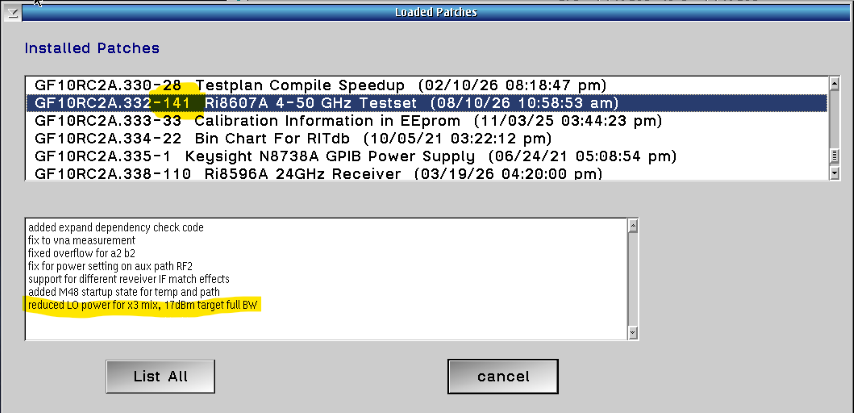
Figure 2. Run Calibration Service Plans


Figure 3. Effect of a 3 dB LO Power Reduction on WpGain Calibration
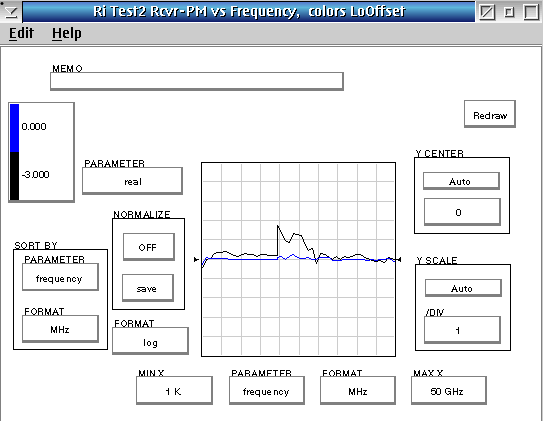
Caption: Reducing LO power by 3 dB causes minimal measurement change, with a worst-case deviation of ~2 dB between 20 and 30 GHz. Most of the band shows negligible impact.